
Showing posts with label commons. Show all posts
Showing posts with label commons. Show all posts
Sunday, June 26, 2011
Learning Spaces Visits at SLA Conference
I have visited libraries and learning spaces from time to time while at a conference, but now I'm thinking of making it a more formal endeavor. Last week at the SLA Annual Conference in Philadelphia, a group of fellow attendees and I visited the Library Learning Terrace at Drexel and the TECH Center at Temple. Both were interesting spaces, particularly in their use of furnishings. I have a bunch of pictures I need to clean up and go through. Until then, here are some photos from Drexel showing the Library Learning Terrace's recent opening and a nice set of images of the Temple TECH Center.


Tuesday, April 12, 2011
7 Things You Should Know About the Modern Learning Commons
I am delighted to be a contributor to the latest in the ELI 7 things series, 7 Things You Should Know About the Modern Learning Commons. I really enjoyed working with the ELI staff and contributors, and it was especially cool to work with learning commons expert Joan Lippincott.
What do you see as the future of learning commons?
What do you see as the future of learning commons?
Wednesday, April 06, 2011
Recent Commons News
My new job and school have kept me away from posting in quite some time. Recently I've noticed a few things I'd like to share:
The Information Commons Discussion Group will be meeting again at the ALA Annual Conference. I don't usually attend ALA, but when I have, this is a must-attend event. Rudy Leon, this year's convener, is collecting ideas for the topic, so please share your suggestions.
Catherine Lavallée-Welch, a friend and fellow SLA member, has recently posted some good ideas about future learning spaces on the SLA 365 blog. She is planning a learning commons at the University of South Florida Polytechnic Library, and I'm looking forward to hearing more about it.
I don't have time to report much news anymore--there are renovations and new openings galore--but David Murray at Infocommons and Beyond is great about keeping us up to date on commons-related news. Check it out!
The Information Commons Discussion Group will be meeting again at the ALA Annual Conference. I don't usually attend ALA, but when I have, this is a must-attend event. Rudy Leon, this year's convener, is collecting ideas for the topic, so please share your suggestions.
Catherine Lavallée-Welch, a friend and fellow SLA member, has recently posted some good ideas about future learning spaces on the SLA 365 blog. She is planning a learning commons at the University of South Florida Polytechnic Library, and I'm looking forward to hearing more about it.
I don't have time to report much news anymore--there are renovations and new openings galore--but David Murray at Infocommons and Beyond is great about keeping us up to date on commons-related news. Check it out!
Sunday, August 15, 2010
Changes for the Uncommon Commons
This month I was appointed the Associate Dean for Academic Affairs and Research at the University of Kentucky Libraries. This is an exciting new position which includes administrative responsibility for all of the public services based in the William T. Young Library as well as nine branch locations. I will have significant planning, budgeting, and development responsibilities, as well as the opportunity to develop new partnerships and initiatives and create an overall vision for library public services with a terrific team.
As a result, I am no longer managing the information commons, though it is a part of the Academic Affairs and Research division. My last hurrah in the Hub will be our annual Hubbub party next week (see 2009, 2008, 2007). At some point I will post a summary of Hubbub #4 with suggestions for future library welcome events.
What will happen to this blog? While I doubt that I will write very often, I do plan to continue sharing stories about library spaces and services, both commons-specific and beyond. I expect you will see me more often on Twitter, sharing articles and other tidbits of interest. But don't unsubscribe just yet. Thanks for reading!
As a result, I am no longer managing the information commons, though it is a part of the Academic Affairs and Research division. My last hurrah in the Hub will be our annual Hubbub party next week (see 2009, 2008, 2007). At some point I will post a summary of Hubbub #4 with suggestions for future library welcome events.
What will happen to this blog? While I doubt that I will write very often, I do plan to continue sharing stories about library spaces and services, both commons-specific and beyond. I expect you will see me more often on Twitter, sharing articles and other tidbits of interest. But don't unsubscribe just yet. Thanks for reading!
Thursday, July 01, 2010
Happy Birthday, Uncommon Commons!
This blog's third year begins today. I've enjoyed writing and have picked up a number of readers along the way (thank you!). Since I started taking classes and have some new responsibilities, I haven't had much time to write. In any case, I still enjoy writing and will continue sharing news and commentary on my own experience in a commons environment.
Some of the most popular posts over the last three years:
Thanks for reading!
Some of the most popular posts over the last three years:
Thanks for reading!
Thursday, June 24, 2010
Georgia Tech Visit
 Earlier this month while at EDUCUASE Southeast Regional, I had the opportunity to visit Georgia Tech, one of the libraries that inspired the Hub. When I visited last summer, the West Commons was still undergoing renovations. I was delighted this time to see the the finished project which is known as 2 West. While I took a number of pictures during the quiet of summer with a pretty lousy camera, you'll really want to check out their website on 2 West which includes a number of images, concepts, presentations, and process documents related to the project.
What particular
 ly captured my attention are the partitions which create somewhat private spaces yet let light flow through. In our own research commons project, we've been pondering how to create the personal spaces that graduate students crave while avoiding any construction or messing too much with the architectural integrity of our building. I was really impressed by this particular design which included copious outlets and whiteboards, another request from our graduate student survey and focus groups.
If you have the opportunity, I urge you to check out their commons--they have always been so user focused and remain one of the most innovative places around.
Tuesday, June 22, 2010
New Thinking on Commons Signage
 So I was wrong.
Labeled with our signature "help help help" sign, our commons desk offers library and IT assistance as well as any kind of directional assistance you might imagine. In addition to the "traditional" things, we've helped students find their advisors, parents find good restaurants, community members find where to print on transparencies, and so on. You know how it goes, and we're delighted to do it. Anyway, I envisioned this desk as the one desk to rule them all: we'll help you with anything, we'll refer you anywhere, just consider us your first stop when you have a question.
So with that line of thinking, I was adamant that we not define the desk with a bunch of signs. If we start describing what we do, inevitably we leave out something. We also make our users choose--is it an IT question or a library question? it's an IT problem, but it's with a library thing, so where do I go? or maybe I shouldn't even bother asking this person since it's neither (here's a rant from last summer about this very topic). So despite the occasional staff suggestion for something more descriptive at each desk, I insisted that we keep it simple.
And what happens when you keep it simple?
Generally I think it works, but I can't count the number of times we've gotten "I'm not sure if you can help me with this..." or "what kind of help?" or even, "do you work here?" While there is a 20 ft sign labeled "help help help" above our heads, I can see where these patrons are coming from. Is this a library help desk to help me with library things, or is it a desk more like the information desks you see in the hospital? You can give me a room number, but you can't actually diagnose anything? Despite a lot of publicity and frequent mention in orientations, tours, and a variety of campus events, until someone is right in front of us with a need, they don't think about what exactly it is that we do.
So I relented. Let's be more specific on our signs.
That's where the fun begins. What do you call it? Reference, research, information, library, Hub, help, assistance...then there's IT, Information Technology, Customer Support, Customer Service, technology, help...We talked about it at length, as I'm sure you have too, and kept struggling with how to label without limiting and yet be descriptive. We hit upon what I think will be the perfect solution with some simple icons (thank you, Jennifer!).
After settling on "Library Help" and "IT Help," we focused our efforts on a few icons to suggest what these terms might mean. We have a terrific graphics group on campus, and I worked with them to come up with a series of concepts (thank you, Kathryn!). Once we had a few possibilities, I showed them to staff and students and asked for feedback. There was some discussion about using which icons on which signs, and particularly if we should use the old-school library icon, but it seemed right. We tweaked the design a few times, and finally settled on our new look which was just installed last week.
Like the "help help help" sign, the new upper signs are visible from the front and back. In addition, the new design gives us the opportunity to lose all those plastic frames lining the desk--ugh--as the lower signs includes space to post hours and announcements as well as hide the impossible-to-hide cords and cables in our very open desk design.

What do you think?
Wednesday, May 19, 2010
NYU Library Visit
Last week I had the pleasure of touring NYU's Bobst Library. I have walked by the massive building so many times but had never been inside--it is a very impressive space.
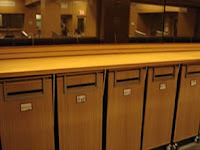 To complement the 2004 renovation of two floors to create the Brine Library Commons for undergraduates, the library is now undergoing a major renovation on two upper floors to develop a research commons which incorporates significant student feedback into the plan.
See thi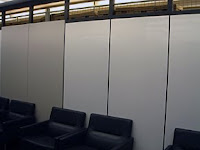 s report for background and this LibGuide for floor plans and other information about the project. The new research commons is scheduled to open in Oct-Nov this year.
The pictures I took did not do justice to the library, but I did want to highlight a couple of creative additions to various spaces: the whiteboard walls in one collaboration space and the reservable portable storage cabinets in another. Neat ideas, particularly with the storage as we have heard repeatedly from our own graduate students how important it is to have large, lockable storage spaces. I am looking forward to my next visit.
 To complement the 2004 renovation of two floors to create the Brine Library Commons for undergraduates, the library is now undergoing a major renovation on two upper floors to develop a research commons which incorporates significant student feedback into the plan.
 See thi
 s report for background and this LibGuide for floor plans and other information about the project. The new research commons is scheduled to open in Oct-Nov this year.
The pictures I took did not do justice to the library, but I did want to highlight a couple of creative additions to various spaces: the whiteboard walls in one collaboration space and the reservable portable storage cabinets in another. Neat ideas, particularly with the storage as we have heard repeatedly from our own graduate students how important it is to have large, lockable storage spaces. I am looking forward to my next visit.
Thursday, April 29, 2010
New Computer Service Desk in the Hub
 This semester Kentucky Trade Computer Services launched their campus location as the official computer service provider for UK students. Conveniently located inside the computer lab in the Hub, they offer computer repairs, upgrades, data recovery, and other related services.
Many commons environments offer hardware services, and I'm glad we were able to add this valuable service to the Hub. Complimenting the services available from the IT help desk, the Hub really is a one-stop shop for student technology assistance.
Check out their website for more information on the services they offer.
New IT Help Desk
 Earlier this month, a new IT help desk opened on campus to meet the needs of north campus students. Located in the student center, the help desk occupies a former travel office (note the groovy bar stools). I think it's terrific that IT continues to move its help desk services to where the students are, and this place should be hopping during the lunchtime rush.
Around the same time, IT also launched a new Tech Tips guide for students.
What an Opportunity!
Here's a chance to lead the planning and management of an outstanding commons environment: NCSU is looking for a Director of Learning Commons Services. This is the place with the seriously cool website, the great furniture, the purple carpet and polka-dotted accents, not to mention the place that checks out all kinds of technology. I typically don't post job ads, but I couldn't resist this one.
Monday, April 19, 2010
Academic Learning Spaces Conference
The Florida State University Libraries and Panhandle Library Network are sponsoring a conference of interest: Academic Learning Spaces: Invention, (Re)Invention, and Innovation on June 7-8, 2010 in Tallahassee, FL. The conference will feature discussions facilitated by Crit Stewart, as well as an assessment workshop, presentations, and poster sessions. See the conference website for full details. This looks like one that commons aficionados won't want to miss!
Tuesday, March 02, 2010
Happy Birthday to the Hub!
 The Hub, the information commons at the University of Kentucky, opened three years ago this month. We were updating our brochures last week, and I realized "the hot new spot on campus" may no longer be accurate. At least it's still a hot spot. We continue to draw huge crowds--new crowds--so that's pretty great. It's definitely been a fun ride, and I am excited about what's next. Stay tuned.
Photos from Hubbub 2008/Young Library 10th Birthday by Alice Wasielewski
Monday, February 22, 2010
Facebook's Learning Commons
Brian at the Ubiquitous Librarian was on to something when he compared Facebook's employee working environment to a learning commons environment. This recruitment video (as well as these images) show their collaborative, colorful, creative environment:
What do you think? Reminds me of today's academic library.

What do you think? Reminds me of today's academic library.
Wednesday, February 17, 2010
Student Technology Forum
 Last night the Hub was host once again to the second annual Student Technology Forum (last year I wrote quite a bit about the event). I think we had a bigger crowd this year; definitely IT offered more prizes--24 of them, including a Dell netbook! The purpose of the forum is to introduce students to IT staff (as well as Libraries and staff from the teaching and learning group) and solicit
  opinions on what works well, what doesn't, etc.
In my mind, it is primarily a nice student appreciation event, but I think we also get a lot of good information from the survey that students complete for the prize drawing. One very clever marketing move from IT was to offer a "second chance" drawing among the students who become fans of IT's Facebook page by the end of today. I bet they'll end up with a lot of fans.
I love hosting events in the Hub--great exposure for our space--and hope we'll plan another event together soon. This did remind me that Hubbub number four is only six months away!
Photos by Tony Jenkins
Tuesday, February 09, 2010
Learning Commons Expansion at UMass
The Learning Commons at the University of Massachusetts W.E.B. Du Bois Library has recently expanded to bring the commons' seating from 250 to 450, and 30,000 square feet of space, including eight new group study rooms.
Looks like a neat place--some photos of their space.
Fact sheet on the Learning Commons

Looks like a neat place--some photos of their space.
Fact sheet on the Learning Commons
Wednesday, February 03, 2010
Learning Commons Conference in Kingston, Ontario
The program and registration information are now available for the 5th Annual Canadian Learning Commons Conference. Titled A Journey in Progress: Been There! Done That! What's Next!, the conference will be held June 16-18, 2010 in Kingston, Ontario. This looks to be an excellent event--wish I could go!
Thursday, January 21, 2010
Info Commons Project Documents
David from the InfoCommons and Beyond blog has posted a link to some interesting documentation from Georgia Tech. The documents seem to be a few years old, but they still provide some good insights:
The good folks at Georgia Tech have posted a very useful set of documents on planning and assessment: focus groups, questionnaires, a case study by Herman Miller, and fascinating essay by freshman Erica Hocking on the the Commons as a "Sacred Space" for learning.If you haven't already, be sure to check out the InfoCommons and Beyond blog--the sidebar contains lots of links to commons spaces around the world, as well as relevant reading, presentations, and other documents.
Thursday, January 07, 2010
Snow Day!
 Once the tiniest amount of snow falls here in Kentucky, out comes the sleds. The hill in front of my library is one of the best sledding spots on campus. Maybe we should start checking out sleds in our commons, especially to those two students using a plastic tarp :-) Seriously, share in the comments if you know of a library/commons that checks out unusual items.
Monday, December 21, 2009
The Computer Lab of the Future
A recent piece in the Chronicle about the transformation from labs to lounges has kicked me back into writing. I couldn't agree more about the need to move away from soldierly rows of computers, elbow-to-elbow, into something more comfortable and flexible. I will get into that in a moment, but first I will point out why we still need computer labs--albeit downsized--for a little while longer.
Certainly this conversation is happening at more and more institutions as we look at ways to cut costs. Do we still need so many computers? Probably not, though we still need some sort of lab environment for three primary reasons:
Provide computers for students who do not have them. We make so many assumptions about our students--today's net generation is always connected, so they must all have shiny new laptops, right? While computer ownership increases each year, many of those are hand-me downs. 17.9% of students surveyed in the 2009 ECAR Study of Undergraduate Students and Information Technology own a computer that is at least four years old and around 1.5% own no computer at all. I would suspect those numbers are even higher in poorer states. Another consideration is those students who have to rely on dial-up access at home; many rural areas still aren't served with high speed access. Rather than work over a painfully slow connection, students in those areas would be more inclined to work in a campus lab. I know my step-sister would. While laptop ownership does increase each year, we continue to have other access issues.
Access to specialized software and equipment. For those connected students who own a fairly new personal laptop, it is likely that they do not have access to specialized software. Why pay for those applications if you only need them for a single class? For those students who run an alternative OS at home, they may need access to a different platform for class work. In addition to software, labs usually offer scanners and printers that students may not have access to at home. Space in a typical residence hall room is at a premium--if you own a printer and/or scanner, why would you take up precious space when you could use the shared resource in the lab? Granted, virtualization will largely solve the expensive, "I just need it for this one class" application issue, but we have to be at a point where campuses are offering a virtualized enviroment that works well and students have equipment that is robust enough to handle virtualized applications. This still doesn't address the issue of scanners and printers and other peripherals--perhaps those will remain a part of the reinvented lab space.
Convenience. If you have a short break between classes, it usually isn't worth going back to your room. This is particularly true of commuter students who often camp out for most of the day on campus. What a great opportunity to get some work done between classes--check the course management system, email, Facebook, and maybe start writing a paper or doing some library research. For those who have a laptop, who would want to lug it around all day, particularly if it is a 4+ year old brick. Even if the laptop is light, why carry it and risk theft or damage--the parents would not be happy! So enter the computer lab (and the library) for computers available for general use at students' convenience. I realize the convenience argument has less weight in these difficult budgetary times, but knowing students, I suspect it remains a much higher priority for them than we realize.
So what's the answer?
Obviously with each year, there will be fewer students who have no computing access outside of a lab. It will be a slow process to see 100% connectivity, especially in poorer states, but that doesn't prevent us from reducing the number of lab machines.
As far as specialized software, more institutions are looking toward virtualization. There are several notable virtualization projects out there already, and I expect we will see more of these in the next couple of years. I hope more institutions will put resources into this area.
So as we slowly reduce the number of lab machines, what do we do with all that space?
I love this trend of making labs more commons-like. We've seen it at other institutions, and we have dabbled with it a bit on my campus with our "Hublets." Based on the commons concept, I see these as a few key elements of the next generation computer lab (assuming the lab isn't part of a library/commons environment already):
Relaxed food and drink policies. It has taken the library years to overcome our fear of food and drink--and many of us are not there yet--but for a space to be student-friendly, we have to be more accommodating. Is it realistic to expect someone to spend several hours in the lab without food or drink? How many hours do you spend at your own desk without food or drink? I did quite a bit of reading and talking to people about food policies before we opened the Hub, and students are generally good about being neat and reporting spills. If you don't modify those outdated policies, you won't be a student destination.
Comfort! In addition to the comforts of food and drink, students need comfortable, reconfigurable furniture. I have just completed a few student focus groups and surveys, and over and over again, students asked that chairs be comfortable enough to sit there for hours. Again, think of your own desk. Would you really sit on a pretty wooden chair all day? Of course not, yet we tend to put really uncomfortable chairs in our student spaces. You don't have to break the bank, either--I've seen several lab and commons spaces that utilized bean bags, ottomans, and pillows quite effectively (check out my pics of the Cox Computing Center at Emory, for example). Flexibility is important as well. Students are going to rearrange furniture unless it is nailed down. And if it is nailed down, students will sometimes need to gather together, so lose the idea of spacing computers only a couple of feet apart.
Fun, funky student influence. Some of the coolest labs I have seen incorporate student art, signs, or other student creativity into the space. One space even had a little ambient music going. If you want to be a destination, you have to create an inviting atmosphere. Think of the coffeehouse. The supermarket-style lighting won't cut it anymore, either.
Friendly, expert help. I still think this is the most important element. While the technology is important--particularly the specialized software and hardware that students would not have otherwise--the key to a successful space is knowledgeable, friendly experts who can provide excellent customer service. Rows and rows of computers watchdogged by sullen techies is not the image to project. When I managed desktop support, I always looked for students who had a great attitude, patience, and the willingness to teach without jargon or arrogance. The tech skills were less important.
What other elements do you see for the computer lab of the future?
Are Computer Labs Still Necessary?
Certainly this conversation is happening at more and more institutions as we look at ways to cut costs. Do we still need so many computers? Probably not, though we still need some sort of lab environment for three primary reasons:
Provide computers for students who do not have them. We make so many assumptions about our students--today's net generation is always connected, so they must all have shiny new laptops, right? While computer ownership increases each year, many of those are hand-me downs. 17.9% of students surveyed in the 2009 ECAR Study of Undergraduate Students and Information Technology own a computer that is at least four years old and around 1.5% own no computer at all. I would suspect those numbers are even higher in poorer states. Another consideration is those students who have to rely on dial-up access at home; many rural areas still aren't served with high speed access. Rather than work over a painfully slow connection, students in those areas would be more inclined to work in a campus lab. I know my step-sister would. While laptop ownership does increase each year, we continue to have other access issues.
Access to specialized software and equipment. For those connected students who own a fairly new personal laptop, it is likely that they do not have access to specialized software. Why pay for those applications if you only need them for a single class? For those students who run an alternative OS at home, they may need access to a different platform for class work. In addition to software, labs usually offer scanners and printers that students may not have access to at home. Space in a typical residence hall room is at a premium--if you own a printer and/or scanner, why would you take up precious space when you could use the shared resource in the lab? Granted, virtualization will largely solve the expensive, "I just need it for this one class" application issue, but we have to be at a point where campuses are offering a virtualized enviroment that works well and students have equipment that is robust enough to handle virtualized applications. This still doesn't address the issue of scanners and printers and other peripherals--perhaps those will remain a part of the reinvented lab space.
Convenience. If you have a short break between classes, it usually isn't worth going back to your room. This is particularly true of commuter students who often camp out for most of the day on campus. What a great opportunity to get some work done between classes--check the course management system, email, Facebook, and maybe start writing a paper or doing some library research. For those who have a laptop, who would want to lug it around all day, particularly if it is a 4+ year old brick. Even if the laptop is light, why carry it and risk theft or damage--the parents would not be happy! So enter the computer lab (and the library) for computers available for general use at students' convenience. I realize the convenience argument has less weight in these difficult budgetary times, but knowing students, I suspect it remains a much higher priority for them than we realize.
So what's the answer?
Obviously with each year, there will be fewer students who have no computing access outside of a lab. It will be a slow process to see 100% connectivity, especially in poorer states, but that doesn't prevent us from reducing the number of lab machines.
As far as specialized software, more institutions are looking toward virtualization. There are several notable virtualization projects out there already, and I expect we will see more of these in the next couple of years. I hope more institutions will put resources into this area.
So as we slowly reduce the number of lab machines, what do we do with all that space?
The Next Generation Computer Lab
I love this trend of making labs more commons-like. We've seen it at other institutions, and we have dabbled with it a bit on my campus with our "Hublets." Based on the commons concept, I see these as a few key elements of the next generation computer lab (assuming the lab isn't part of a library/commons environment already):
Relaxed food and drink policies. It has taken the library years to overcome our fear of food and drink--and many of us are not there yet--but for a space to be student-friendly, we have to be more accommodating. Is it realistic to expect someone to spend several hours in the lab without food or drink? How many hours do you spend at your own desk without food or drink? I did quite a bit of reading and talking to people about food policies before we opened the Hub, and students are generally good about being neat and reporting spills. If you don't modify those outdated policies, you won't be a student destination.
Comfort! In addition to the comforts of food and drink, students need comfortable, reconfigurable furniture. I have just completed a few student focus groups and surveys, and over and over again, students asked that chairs be comfortable enough to sit there for hours. Again, think of your own desk. Would you really sit on a pretty wooden chair all day? Of course not, yet we tend to put really uncomfortable chairs in our student spaces. You don't have to break the bank, either--I've seen several lab and commons spaces that utilized bean bags, ottomans, and pillows quite effectively (check out my pics of the Cox Computing Center at Emory, for example). Flexibility is important as well. Students are going to rearrange furniture unless it is nailed down. And if it is nailed down, students will sometimes need to gather together, so lose the idea of spacing computers only a couple of feet apart.
Fun, funky student influence. Some of the coolest labs I have seen incorporate student art, signs, or other student creativity into the space. One space even had a little ambient music going. If you want to be a destination, you have to create an inviting atmosphere. Think of the coffeehouse. The supermarket-style lighting won't cut it anymore, either.
Friendly, expert help. I still think this is the most important element. While the technology is important--particularly the specialized software and hardware that students would not have otherwise--the key to a successful space is knowledgeable, friendly experts who can provide excellent customer service. Rows and rows of computers watchdogged by sullen techies is not the image to project. When I managed desktop support, I always looked for students who had a great attitude, patience, and the willingness to teach without jargon or arrogance. The tech skills were less important.
What other elements do you see for the computer lab of the future?
Subscribe to:
Posts (Atom)

